
Research ICT Africa (RIA) recently organised three sessions at the Internet Governance Forum (IGF) in Oslo, focusing on DPI data governance, innovative regulatory strategies for digital inclusion, and the coordination of G7 and G20 processes for human rights-centred AI governance. These sessions align with our ongoing programmatic work, including the Just AI and Data for Development (D4D) initiatives, and our current technical support for the G20 Digital Economy Working Group. This blog looks at the key discussions from these sessions, and reflects on the overarching IGF and the WSIS process.


Towards Effective Data Governance of Digital Public Infrastructure
Digital Public Infrastructures (DPI) has become somewhat of a buzz topic, with its promise to make the delivery of public goods more inclusive and equitable. This session, moderated by Pria Chetty and Jamie Fuller, brought together perspectives across the public and private sectors to deep dive into the data governance required for DPI to realise its transformative potential. Among the core challenges that emerged from the discussion was the threat that DPI may end up furthering (rather than addressing) the monopolistic control of digital services, and strengthening private data extraction mechanisms that monetise public data with minimal societal return. Such a negative outcome is an example of what RIA has recurrently highlighted – that digital tools, even when deployed in the name of “development”, tend to deepen rather than to close digital inequalities, and the socio-economic disparities that underlie them.
Panellists offered diverse perspectives on solutions to strengthen the requisite data policies for equitable and inclusive DPI outcomes. Public sector expert Souhila Amazous emphasised the need to focus on capacity building so that the existing progressive data governance policies – notably those highlighted in the African Union Data Policy Framework (AUDPF) – can be effectively implemented. Andrew Vennekotter from Amazon Web Services called for standards and risk-based regulations to be harmonised to support collaboration between sectors and across nations, and policy agility to keep up with the rapid development of technologies. Payal Malik, Thomas Linder and Mariana Rielli provided civil society perspectives, spotlighting the unique position that civil societies hold, offering a third, balancing dynamic to the private-public relationship that is characteristic of DPI. Payal Malik unpacked the need to move towards enforceable rules on data usage, including fair access, purpose limitation, and benefit-sharing obligations – explaining that such safeguards can prevent anti-competitive entrenchment and ensure DPI-generated data remains a public good rather than a source of private monopolisation. Thomas Linder detailed the various established avenues for civil society organisations to empower local and/or contextual voices in the design and implementation of DPI. He highlighted that data trusts with the right licensing (like NOODL) can make data available for good use while ensuring fair compensation for data producers. Lastly, Mariana Rielli stressed that rights-based governance must be embedded into the technical design of DPI from the start. She argued that data protection laws, while not sufficient on their own, offer essential principles and tools to promote transparency, accountability, and public trust.
Innovative Regulatory Strategies to Digital Inclusion
In line with one of RIA’s key programme areas, this workshop aimed to outline the main demand-side barriers to digital inclusion and discuss innovative regulatory, industry, and market solutions necessary to overcome these challenges. Alison Gillwald facilitated the session and, drawing from findings from the After Access surveys, highlighted that the core issue is that conventional policy and industry interventions primarily address connectivity barriers by expanding internet infrastructure. Bringing together experts from the International Telecommunications Union, GSMA, the Association for Progressive Communications, Internet Society, and Resilience Capital Ventures, the workshop recognised that, although infrastructural supply-side measures are important, they only address part of the problem. Many people, particularly in the Global South, live in areas with internet access, yet other barriers prevent them from effectively and meaningfully accessing and using the internet. Factors such as device and mobile data affordability, as well as a lack of education and digital skills, continue to exclude many from meaningful digital engagement.
One of the key takeaways was that we should encourage and promote smaller telecommunications operators and service providers. Comparing digital inclusion to a jar that needs filling, Steve Song of the Internet Society described large, traditional mobile operators to big stones—filling some space but leaving many gaps that cannot be filled by similar large actors. Instead, smaller, more adaptable players such as community network operators should be empowered to fill these gaps.
From a governance perspective, interventions to improve digital inclusion can no longer be managed solely by one or two government departments. What is needed is a cross-cutting, multifaceted, and coordinated strategy across government that addresses infrastructure supply alongside skills development, device and data affordability, and the promotion of locally relevant content and applications. The workshop gathered perspectives from speakers and attendees on how this can be achieved, and resolved to continue these essential discussions. Its associated research paper is available here.
Advancing Rights-Respecting AI Governance and Digital Inclusion through G7 and G20
This IGF Open Forum was co-organised by RIA together with the Tech Global Institute. It brought together representatives from the governments of Canada (the current G7 President), South Africa (the current G20 President) and Brazil, who held the G20 Presidency in 2024. Speakers discussed the ongoing priorities of the G7 and G20 relating to AI, DPI and digital inclusion, drawing out similarities and differences between the two international fora. A focus of the discussion was what both fora were doing to promote the safe and meaningful use of digital technologies in the Global South, since the G20 is now in the fourth and final year of leadership by an emerging economy.
To consolidate this, Deputy Minister Mondli Gungubele of the Department of Communications and Digital Technologies (DCDT) explained that the South African G20 Presidency has sought to bring a Global South perspective to these important discussions to ensure that they have a seat at the table on the international stage. While the G7 has no Global South representation in its membership, Alison O’Beirne, Director of the AI Hub in Innovation, Science and Economic Development Canada, discussed how Global South countries and markets were important considerations for the advanced economies as their active involvement and participation are crucial in building a truly global ecosystem.
Policy Network on AI Governance
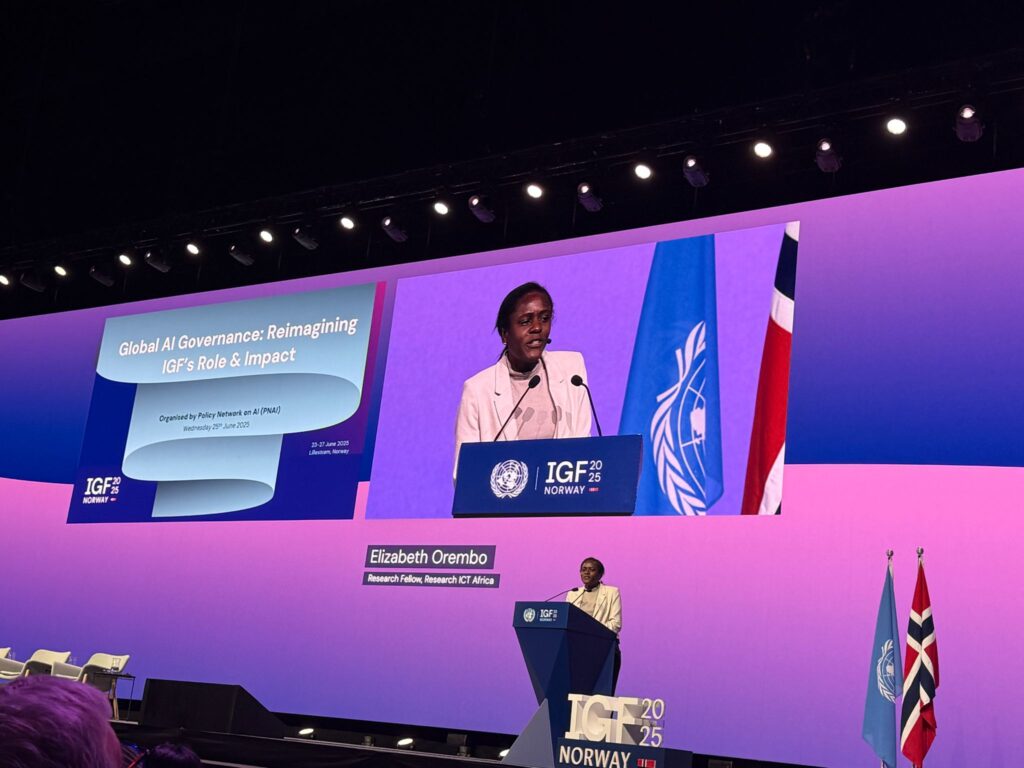
During a session organised by the IGF Policy Network on AI (PNAI), moderated by Liz Orembo, concerns were raised about how the PNAI can foster a trusting environment and incorporate the values of the IGF and WSIS into its AI governance processes. African participants in these sessions were concerned about cross-border data flows; and how data generated by Africans is mostly held and extracted abroad, despite a growing need for Africans to use this data for its own AI development. Access to data for research on AI governance and electoral information integrity was also mentioned, highlighting the work that RIA has undertaken to facilitate data access for the public interest, which also necessitates the governance of data as a public good.
Transparency and explainability emerged as central concerns, with participants emphasising that AI systems must be comprehensible to those affected by their decisions. The “black box” nature of many AI systems poses fundamental challenges to democratic accountability and human rights protection. A central debate focused on whether existing legal frameworks covering privacy, competition, and intellectual property are sufficient, or whether entirely new regulatory instruments are needed to address AI’s novel challenges.
While recognising the need for international cooperation, speakers stressed that AI governance must be tailored to local contexts, values, and development priorities, rather than adopting one-size-fits-all solutions. The discussions revealed a growing consensus that effective AI governance requires both global coordination mechanisms and a strong local capacity to adapt and implement governance frameworks that reflect diverse cultural, economic, and political contexts.
The WSIS process and the IGF
Despite 20 years of WSIS, IGF sessions revealed that many of its goals, particularly in digital inclusion, capacity building and bridging digital divides, remain unfulfilled, especially in developing countries. Countries and regions are still facing persistent digital inequalities, and more so with the continued emergence of new technologies. Calls for WSIS to include solutions and metrics for demand-side access were more persistent, as it was in the Global Digital Compact process.
As the WSIS +20 review comes at a time of intense geopolitical tension, the core challenge now confronting the international community, and indeed the IGF, lies in ensuring that the WSIS principles are not merely acknowledged but actively integrated and codified into the burgeoning UN and broader multilateral processes. This integration is vital as new norms, regulations, and governance paradigms emerge to grapple with the increasingly intricate and interconnected topics that define the digital age. The successful navigation of this challenge will determine the future trajectory of Internet governance, ensuring it remains a force for good in a rapidly evolving world.
A key focus of the WSIS resolution was a call for the IGF to be granted a permanent mandate. This desire for permanency may stem from the recognition that future global governance of digital technologies will likely be more politicised, making it more difficult to achieve consensus on its renewal, given the increasingly political nature of internet governance and current challenges in global diplomacy since WSIS’s inception.
Beyond an exchange of ideas, the IGF has fostered global and national collaboration, with National and Regional IGFs (NRIs) successfully establishing multistakeholder governance processes in many instances. However, many countries, including those in Africa, struggle to include stakeholders like the private sector and government in their IGF discussions. The global IGF has not been left out, as it is also experiencing declining private sector participation, and some governments prefer other multilateral processes within the UN, EU, and OECD. This trend reflects a broader shift in global internet governance, where stakeholders increasingly opt for direct collaboration with specific actors, leading to a shrinking space for civil society participation, exemplified by direct lobbying of governments by private actors.
Despite the intention for NRI conversations to inform subsequent IGFs through a bottom-up policymaking process, this reporting structure has largely failed. The regional and global IGFs don’t have strong reporting mechanisms through which NRIs can feed into. Furthermore, very few NRIs are effective, especially in Africa. Where they have worked, we have seen a stronger collaboration between stakeholders, including the government, the private sector and the NGOs. Successful NRIs have also demonstrated multistakeholderism through local actor support, such as Small to Medium Enterprises (SMEs) and large enterprises sponsoring national IGFs.

Conclusion
The ongoing challenges of digital inequality and the evolving landscape of global internet governance necessitate continued multi-stakeholder collaboration and a renewed commitment to the WSIS principles. As the digital age progresses, ensuring that governance structures are adaptable, context-sensitive, and truly representative of diverse global voices will be paramount to fostering a truly inclusive and beneficial digital future.