
Research ICT Africa launches findings from the Governance of Harmful Online Content study on the International Day for Universal Access to Information.
In a digital age where data lives on indefinitely, images are easy to manipulate, and content origins are often hard to track, enforcing digital rights is not an easy task. Likewise, when harm goes viral, it will take more than content restrictions alone to repair the damage. This is particularly true in South Africa, where information disorders have played a significant role in amplifying political tensions, and where fragmented governance makes remedies inaccessible.
Already grappling with severe social inequality, unprecedentedly high levels of gender-based violence, and a long history of ethnic and racial tensions, the nation’s fractured socio-political landscape makes it an easy target for disseminating hate speech, mis-, dis-, and mal-information over social media platforms. Targeted campaigns such as the xenophobic rhetoric of the recent March to March campaign, 2024’s orchestrated interference with the IEC and national elections, 2016’s Bell Pottinger scandal, and other politicised attacks including foreign state-sponsored operations, all point to the nation’s vulnerabilities to weaponised digital media.
Which is why, on 17 September 2026, ahead of the International Day for Access to Information on 28 September, stakeholders gathered in Johannesburg to discuss the governance of online harmful content and freedom of expression in South Africa. The event, which took place under the overarching theme, ‘Upholding Information Integrity in the Digital Age: The role of access to Information in addressing Information Disorder’, took an evidence-based approach to strengthening information integrity, and advancing inclusive, democratic digital societies.


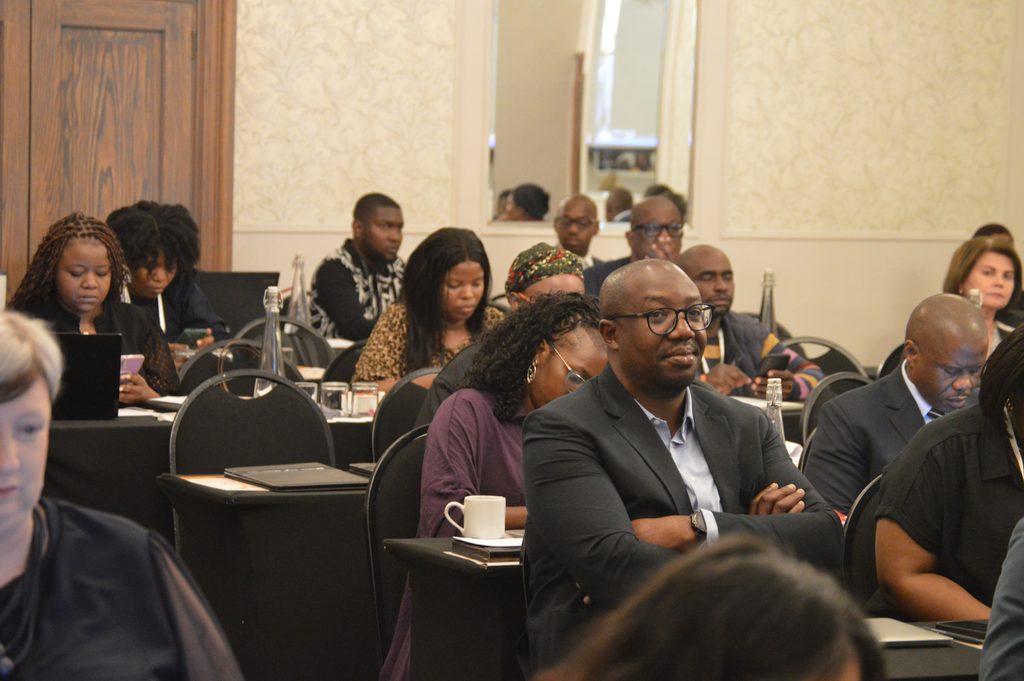
Minister Solly Malatsi from the Department of Digital Communications and Technologies, opened the event, reflecting the far-reaching nature of harmful online content. From press and journalists, to content moderators, Information Regulator representatives and affected communities, each person in attendance had a unique story to share about how digital technology had negatively impacted their lives. Whether it was a friend, a child or a partner, participants readily voiced grave concerns around platforms’ creeping impact on their safety.
Addressing these anxieties was the launch of findings and recommendations from a joint national study by Research ICT Africa (RIA), the Centre for Analytics and Behavioural Change (CABC) and Moxii Africa. Produced under the EU-funded Social Media 4 Peace initiative in South Africa, the study sought to analyse South Africa’s digital governance landscape, and investigate the utility of international platform governance standards and interventions within a local context, including UNESCO’s Guidelines for the Governance of Digital Platforms. To do this, researchers used a three-pronged methodology of legal and regulatory analyses, social media monitoring, and insights from more than 30 key informant interviews to deduce South Africa’s capacity to protect freedom of expression while addressing harmful content.
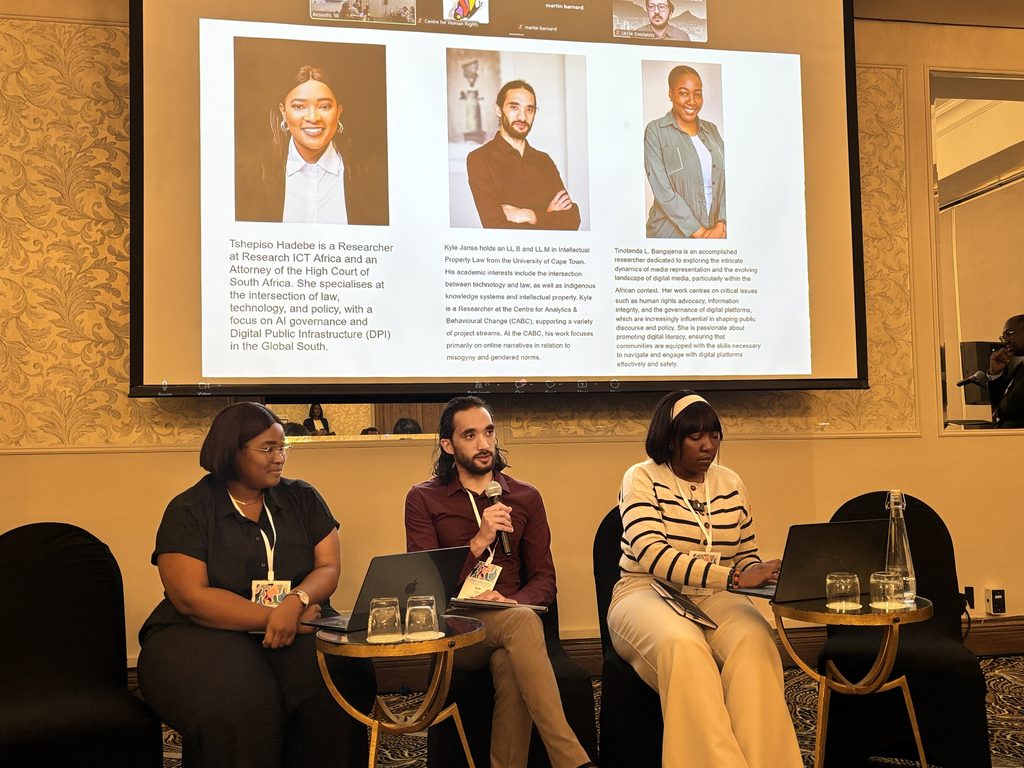
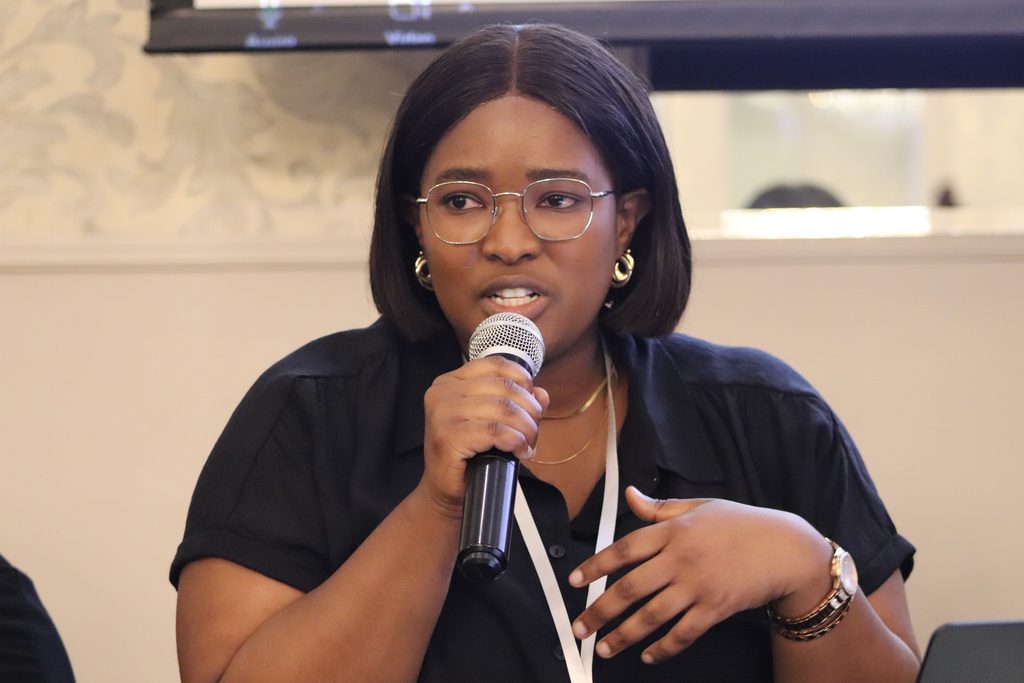
Presenting the report’s key findings in the opening session moderated by Leslie Dwolatzky (RIA), panellists Kyle Janse (CABC), Tshepiso Hadebe (RIA) and Tinotenda Bangajena (Moxii Africa) confirmed that digital harms both reflected and exacerbated ongoing conflicts across the country, while also altering their speed, scale and reach.
“While offline harms are reflected online, cyberspace also goes a step further in shaping how that harm perpetuates online, how it evolves, and what we see reflected on social media. And in terms of platforms’ own responses, we find that their responses are fragmented across all spheres,” said Janse.
These platform responses are not only limited, but also largely obsolete in South Africa’s distinct cultural context. As Janse explained: “We need to strengthen local contextual capacity. In South Africa, we have 11 official languages. If we just moderate in English, and AI moderation is only set up in English, then we are essentially leaving out 10 different languages spoken frequently in this country.”
Similarly, with the bulk of platform governance being controlled by platforms themselves – through community guidelines that censor content according to internal standards – users across the world are reliant on private Global North companies to facilitate safe spaces online. However, not all platforms mirror the same constitutional principles.
“We don’t have consistency across moderation in different social media platforms. There’s no common standard for what constitutes hate speech, what can be removed, what is moderated, and the like,” said Janse. Hadebe shared an example, saying: “If you look back to the South African Human Rights Commissions’ 2024 submission to the Meta board on the continuous display of South Africa’s apartheid flag on Facebook, this just goes to show that this globally standardised moderation policy fails when it comes to accounting for the particular South African context.”
These platform governance limitations touch on deeper problems surrounding how platforms and their supporting tools are designed, and with who in mind. As Bangajena importantly noted: “It’s about whether the platforms understand who they are protecting and the context in which the harm is happening.”
With content moderation’s limited linguistic, political or social relevance, victims of harm frequently find themselves with limited escalation pathways and remedies, making it difficult to report harms or secure accountability in any real, timeous ways. A refrain from participants was that South African law enforcement was ill-equipped to manage digital harms, and victims often cited ridicule from police officers, reductive instructions to ‘just block’ perpetrators, and exceptionally long timelines (up to 7 years) for handling disputes related to harassment, doxxing, noncontextual sharing of intimate images, sextortion, and AI-generated deepfakes.
On this note, Bangajena said: “Online safety is connected to much bigger issues: participation, access to information, safety, and democracy. If I had to take one lesson from conducting these interviews, it would be that we can’t understand online harms by looking at technology alone.”
Zooming out to South Africa’s wider governance architecture, Hadebe pointed out that the problem here was not in the lack of legal pathways for prevention, it was in lack of enforcement and coordination. Comprehensive legal analysis revealed that South Africa has incrementally built an advanced regulatory system, sufficiently to manage digital harms through the Protection from Harassment Act, Domestic Violence Amendment Act, Cybercrimes Act, Prevention and Combating of Hate Crimes and Hate Speech Act, the Promotion of Equality and Prevention of Unfair Discrimination Act, and Section 16 and 36 of the South African Constitution.
Hadebe continued: “South Africa has multiple laws and institutions, all of which have a relevant mandate to online harms, but the governance remains fragmented.” In this sense, the existence of these remedies on paper does not necessarily translate into an effective remedy in practice.
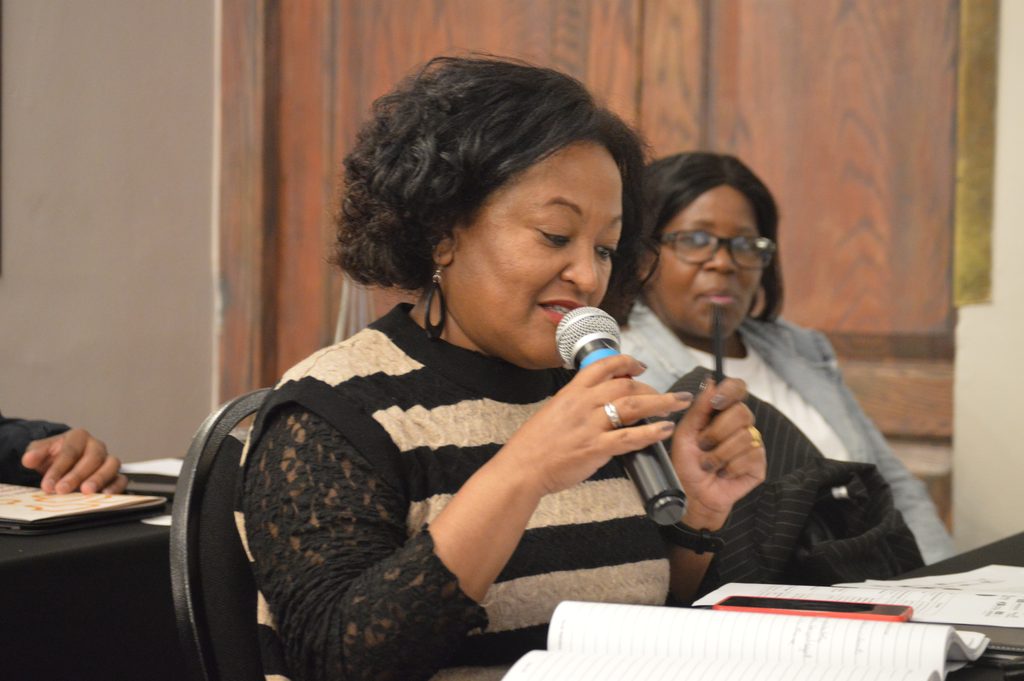
Instead, strengthening resilience to harmful online content in South Africa, requires multisectoral action towards implementing: “A coordinated governance ecosystem where institutions are capable of responding to online harms, where the platforms are held accountable for risks that their own systems create or amplify, and where affected individuals can meaningfully access remedies.” And most importantly, where: “communities to have the media and information literacy they need to navigate this increasingly complex information environment,” said Hadebe.
Overall, the timely report launch underscored the dire need for coordination action towards a more democratic digital society, and the role that the national government can play in curbing platforms’ largely unchecked harms. Charting clear policy recommendations for specific stakeholders, the national study evidences clear harms, while also offering South Africans an opportunity to take ownership over intensifying online tensions, and empower themselves against mediated threats. As Janse aptly put it, “We need to look at what is amplified, how our algorithms amplify harmful narratives, and what gets recommended to individuals, children, young men and the youth across the board.”