
The price of connection in Africa: Evidence from the Retail Africa Mobile Pricing (RAMP) Index (Q4 2025)
We analyse the monthly cost of a 1GB basket of mobile data among African countries, as per the Research ICT Africa’s Retail Africa Mobile Pricing (RAMP) Index for Q4 2025. Prices are presented in USD, adjusted using prevailing quarterly average exchange rates, even though data were originally collected in local currencies. A total of 44 countries (where data were available) were evaluated, focusing on extremes in mobile broadband pricing based on the lowest package available for every service provider. The prices are collected for data baskets of 100MB, 500MB and 1000MB (1GB), valid for 1 day, 7 days and one month. For this analysis, we only focus on the 1GB basket valid for one month.
The chart below displays the top 10 and bottom 10 African countries based on the cost of a 1 GB mobile data basket in USD (primary axis) and their corresponding rankings among the countries assessed (secondary axis), where data were available for Q4. Rankings are inverted, 1 = cheapest, 44 = most expensive. All countries are ranked 1-44, confirming the consistency between price and rank. Rankings add interpretive power to price analysis by showing relative positioning in the continental context. The strong linear alignment between higher prices and lower affordability ranks indicates that the RAMP Index’s methodology accurately captures pricing disparities.
Figure 1: Prices of 1GB monthly basket (USD), Q4, 2025
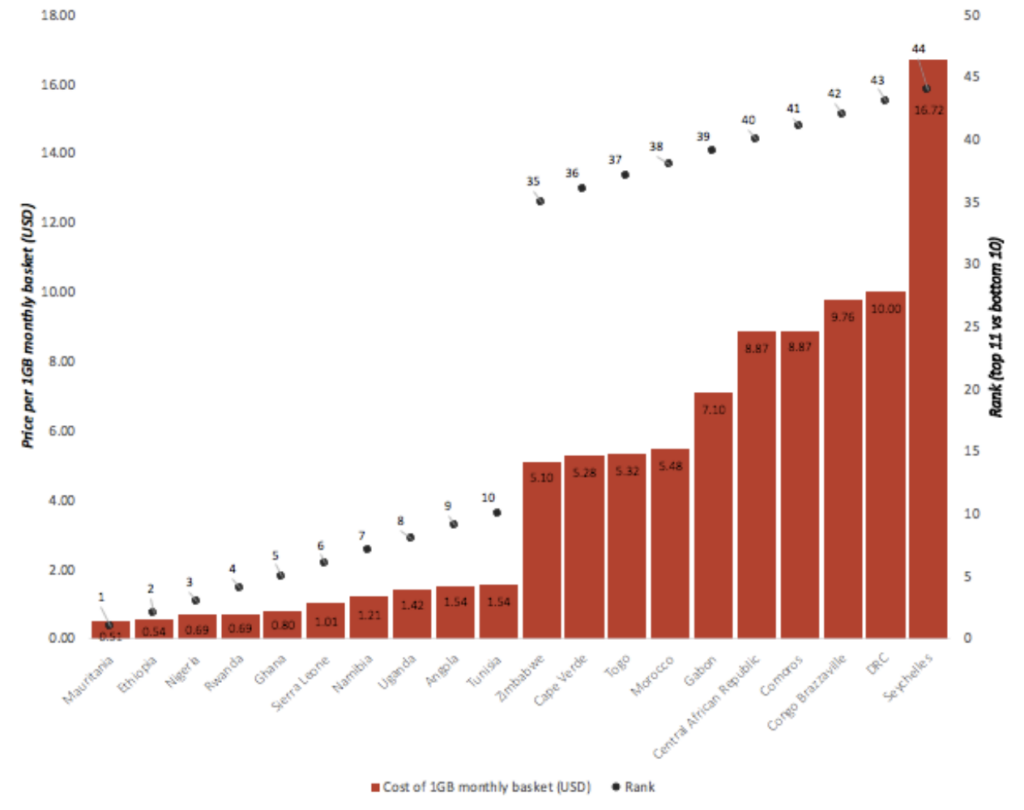
The price clustering below $1.54 and high rank values (1-10) indicate low nominal pricing and efficiency in mobile data pricing. Mauritania offered the best price for 1GB monthly basket, which was priced at 200 Mauritanian Ouguiya (MRO200), equivalent to USD0.51, and this was offered by Mattel’s prepaid EzyenNet Packages data valid for 30 days. Mattel, which is now part of Telecel commands the second largest market share in Mauritania. Ethiopia, Rwanda, Nigeria, Ghana, and Uganda are among the top ten countries with the cheapest basket of 1GB basket. According to the 2022-2023 After Access survey insights, low prices in these countries are attributed to low average incomes, necessitating price-sensitive pricing models.
High mobile penetration rates enable providers to spread infrastructure costs across larger user bases. Local production or negotiation of lower bandwidth prices, often with support from multilateral partners. However, it is worth noting that comparative prices in USD may have changed due to exchange rate fluctuations, rather than shifts in real tariffs in local currency. For example, if a local currency depreciates, the dollar equivalent cost could rise even if nominal tariffs remain unchanged. Exchange rate shifts may have worsened rankings for some countries, where domestic tariffs may not have changed, but local currency appreciation/depreciation has deflated/inflated USD equivalents.
While the top 10 prices are tightly clustered below $1.54, the bottom 10 range widely, from $5.10 (Zimbabwe) to $16.72 (Seychelles), showing extreme differences in affordability within the bottom tier. The average price in the bottom 10 ($8.25) is about eight times higher than the average price of the top 10 performers ($0.99). The general trend confirms the inverse price-affordability relationship. Seychelles, with a price of $16.72, and DRC ($10) are both the most expensive and lowest-ranked countries. Greater variability (std. dev. = $3.56) in the bottom 10 suggests systemic inconsistency in pricing and affordability, whereas the top 10 cluster around a stable, low-cost model (std. dev. = $0.41).
Higher data prices in Seychelles are mainly attributed to the fact that most of the mobile network infrastructure there is imported, and there is limited competition among service providers. Seychelles has a low population base, which makes it a relatively high-income country relative to other African countries in terms of GDP per capita. Additionally, the small population size in Seychelles results in low economies of scale because it makes it difficult to recoup infrastructure costs affordably. Also, Seychelles and other island states like Comoros and Cape Verde face geographical and logistical challenges, which complicate the infrastructure rollout and increase reliance on costly undersea cable access. In countries like the Central African Republic, there are weak regulatory frameworks or a lack of cost-based pricing models. Also, high costs in fragile and post-conflict contexts such as the DRC may be due to limited investment due to political instability, damaged or outdated telecommunications infrastructure.
These cost barriers are reflected in regional digital divides, where West and East Africa outperform Central Africa and parts of Southern Africa in mobile affordability and access. This has downstream effects on digital inclusion, education, economic participation, and access to digital public services.
Regional Implications and Policy Considerations
- Structural constraints drive high prices in island states such as the Seychelles, Cabo Verde, and Comoros. Limited competition, small markets, geographic isolation, and reliance on costly international bandwidth restrict economies of scale and keep data unaffordable.
- Inclusive policy approaches in East and West Africa demonstrate that low pricing data is achievable. Ethiopia, Nigeria, Rwanda, and Ghana have reduced prices through state-supported infrastructure rollout, infrastructure sharing, and stronger competition, enabling broader coverage and improved affordability.
- Market concentration and weak regulation in lower-ranked countries contribute to persistently high costs. Strengthening competition policy, regulatory oversight, and regional coordination is essential to advance equitable digital inclusion.
- Exchange rate volatility also affects price rankings, as the RAMP Index reports prices in United States dollars. Currency movements may shift positions even when local tariffs remain unchanged, underscoring the importance of purchasing power parity adjustments, which are released annually.
In conclusion, the RAMP Index for Q4 2025 highlights the enduring disparities in mobile data pricing across Africa, revealing a strong association between prices, regulatory frameworks, market structure, and broader structural conditions. Although countries such as Mauritania, Ethiopia, Nigeria, and Rwanda illustrate how deliberate policy reform and market interventions can reduce costs and broaden access, several others continue to face high prices driven by limited competition, infrastructure deficits, and geographic or political constraints. Bridging the pricing divide and advancing meaningful digital inclusion will require strengthened regional coordination and evidence-based policymaking, particularly measures that enhance competition, enable infrastructure sharing, support cost-oriented pricing, and incentivise domestic investment. Absent such reforms, the continent’s digital transformation agenda risks entrenching existing inequalities rather than alleviating them


