
Human rights considerations usually enter AI governance too late, once a system is deployed, harms have surfaced, and courts get involved. The United Nations’ B-Tech Project, which aims to provide an authoritative and broadly accepted roadmap for applying the UN Guiding Principles on Business and Human Rights (UNGPs) to the development and use of digital technologies, sought to address this ‘too-little, too-late’ problem with a toolkit to incorporate human rights throughout the AI lifecycle.
On Wednesday, 8 July 2026, the UN Human Rights Office (OHCHR), the Global Network Initiative, Global Partners Digital, and the Centre for Communications Governance held a side event to discuss human rights issues throughout the lifecycle of AI. Themed ‘Innovating responsibly – Embedding human rights in AI product development’, Research ICT Africa was represented by Executive Director, Dr Pria Chetty, who spoke alongside members of the OECD, Japan’s AI governance community, Women at the Table, and the Internet Lab.
Finding a common diagnosis for AI product design and development
Panellists noted that the problem with most AI products reaching African, Asian, or Latin American markets is that they are generally designed elsewhere and lack specifications for local regulatory realities, data conditions, and labour markets. As a result, due diligence turns into a compliance exercise completed before the product ever arrives, and human rights becomes an afterthought.
The panel, therefore, sought to support more inclusive human rights due diligence by asking: How can we redistribute responsibility for AI harms by embedding people-first considerations across the entire AI product development chain? And more specifically, how can the B-Tech Toolkit support this?
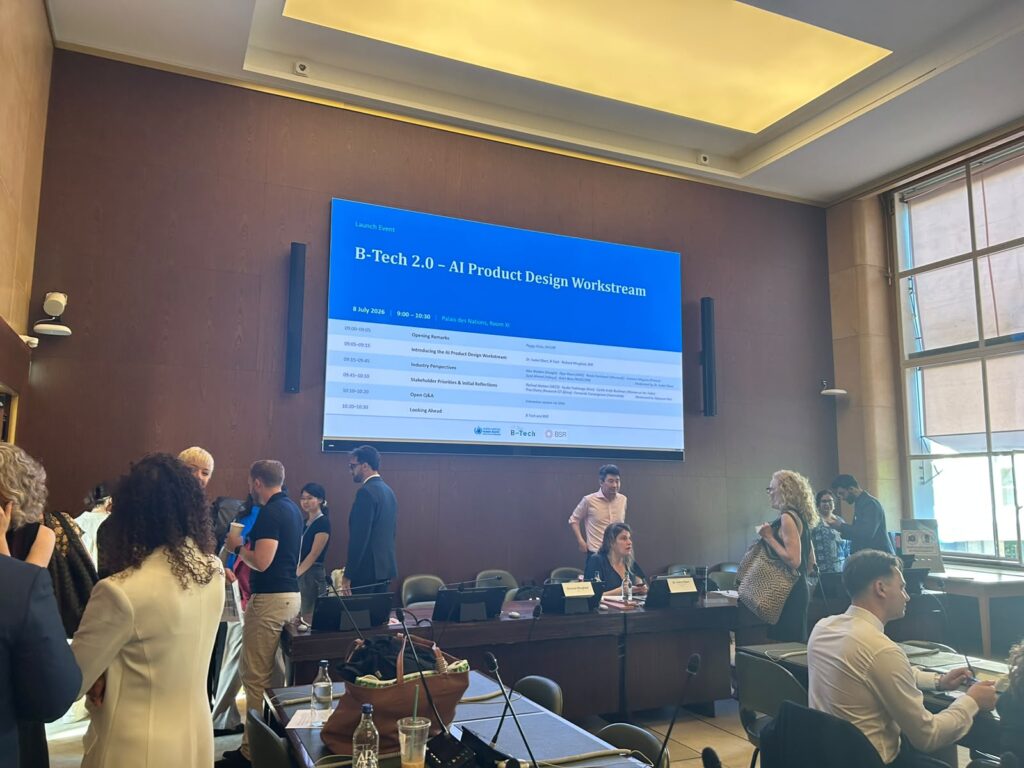

Responding to this question, the OECD noted that the UN Guiding Principles and responsible business conduct frameworks already provide the due diligence architecture companies need – the problem is their harmonised implementation and enforcement. Building on this, the Japanese community noted that soft-law governance only takes effect through developers’ everyday choices about data, testing, safeguards, and oversight. In this sense, responsibility needs to begin at the development phase.
For this to happen, however, Women at the Table called for representativeness to become a scientific standard before any public-sector deployment, as it would allow diverse actors to shape and respond to AI decision-making. Equally, if these actors shared a common understanding of technical and human rights terminology, they could advocate for better compliance across the product lifecycle. Latin American colleagues echoed these sentiments, noting that design-level interventions are needed when legal responses fall short.
Extending the Just AI Framework to support Human Rights Due Diligence
Steering the conversation toward RIA’s Just AI Framework of Inquiry, Dr Chetty asked that AI governance be judged against the real structural conditions of the places where technologies land, rather than the assumed conditions of the places where they are made. She argued:
“Human rights live outside constitutional courts and post-harm adjudication, and the regulators closest to people’s daily experience carry obligations they have yet to claim, because a product can comply fully in the jurisdiction that designed it and still fail the community that receives it.”
For example, ICT regulators sit between AI-delivered health and education services and the people who may actually be harmed by their uneven deployment. To redress this, Dr Chetty called for data protection regulators to set clear red lines for purpose-driven data collection, and provide communities with workable ways to limit or withdraw their consent. Additionally, competition regulators should examine how AI innovation affects local labour and productivity alongside their usual market-entry analysis.
Dr Chetty also called for writing human rights obligations into the same technical and performance specifications that product teams already produce, so that human rights conditions move with the product and can be adjusted in real time. She also challenged civil society, ourselves included, to hold on to the language of human rights rather than softening it. She said:
“Transparency satisfies the right of access to information, and cybersecurity speakers to humans’ right to security and protection. These requirements hold regardless of geography or language, because the Universal Declaration does not scale down at borders.”
Human rights as an imperative, not an afterthought
The UN Business Principles on Human Rights and the B-tech resources on AI provide a guiding framework for evaluating and deploying AI technologies in a manner that extends Research ICT Africa’s own Just AI Framework of Inquiry. As the B-Tech project pushes to produce and disseminate its Product-Level Human Rights Due Diligence Guide and other interactive events and policy briefs, the Research ICT Africa team remains eager to bring our work from the Just AI project to inform its ongoing development and implementations.
As agentic AI platforms proliferate worldwide, data usage Ts & Cs expand to include more and more of our personal information, and AI tools become ubiquitous in both the workplace and people’s daily lives, the timely release of these resources and the essential dialogue they evoke reinforce the reality that human rights compliance and Just AI governance are urgent imperatives, not afterthoughts.